Split Rail Fence Cost Per Foot
Independent research · Last reviewed September 2026 · Costs are 2026 planning estimates, not quotes
The short answer
A split rail fence costs about $15 to $40 per linear foot installed in 2026 — most jobs $20–$30, or roughly $4,500 to $10,500 for 300 feet. It is the cheapest wood fence per foot and one of the best-looking on a large lot, and it contains nothing at all until you add wire. Species and rail count set the price; posts set in tamped earth, not concrete, set the lifespan.
Split rail cost by wood
Species is the biggest lever, and it is regional in a way few fences are: cedar is the cheap local option in the Northwest and an imported premium in the Midwest; hemlock is everywhere in New England and nowhere else.
| Wood | Installed / ft | Life | Notes |
|---|---|---|---|
| Pressure-treated pine | $12 – $22 | 10–15 yrs | Cheapest and most widely stocked. Dries, checks, and can twist; the rails shrink loose in the mortises. |
| Hemlock / spruce | $12 – $20 | 8–12 yrs | Common in the Northeast because it is local. Rots fastest; treat it as a short-term fence. |
| Cedar (western red / northern white) | $18 – $35 | 15–20 yrs | The classic. Rot-resistant, light, greys evenly. Regional price swings are large. |
| Black locust | $22 – $40 | 25–30+ yrs | The longest-lived wood rail there is; dense, heavy, and only stocked in some regions. |
| Vinyl (post-and-rail) | $18 – $32 | 20–30 yrs | Never rots and never greys; 16 ft rails mean fewer posts. Cracks in hard cold if it is thin-wall. |
| Composite / aluminum rail | $25 – $45 | 25–40 yrs | Niche products that look like painted board fence. Priced closer to ornamental fencing. |
Roughly $10–$20 of that is material and $5–$15 is labour. Labour is low for a fence because there are no boards to hang — the whole job is post holes, and rails drop into mortises in minutes. That is also why rocky ground moves the price more here than on any other fence type.
2-rail vs 3-rail: height, price, and what each is for
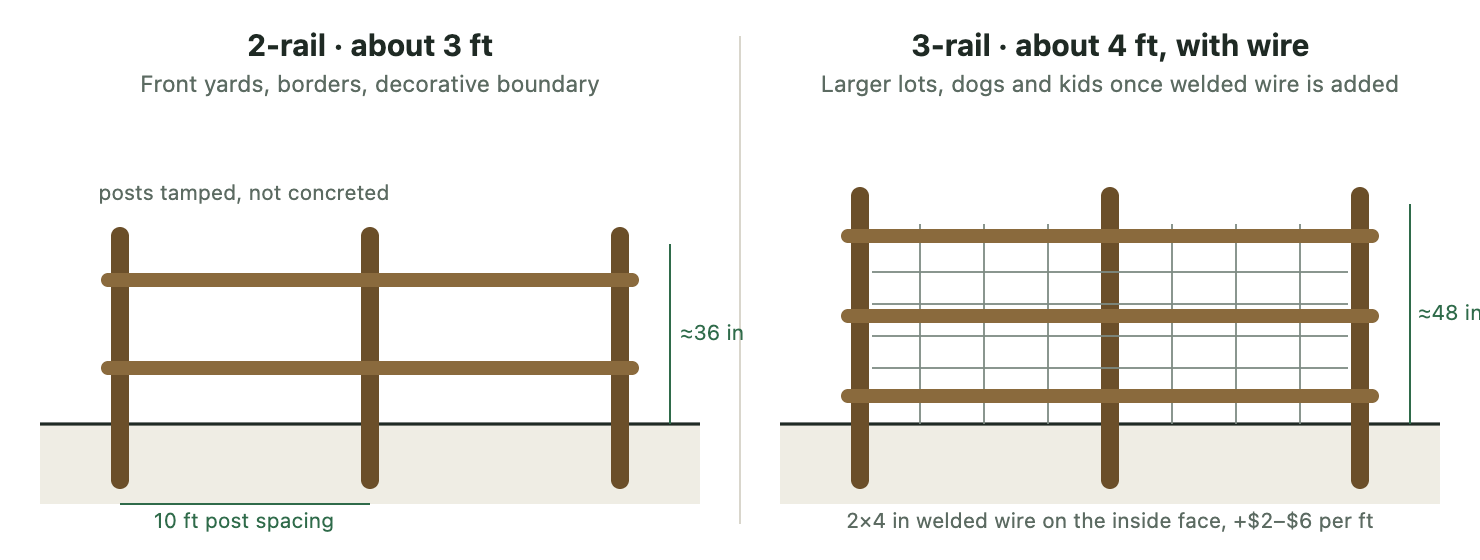
| Rails | Height | Price | Use |
|---|---|---|---|
| 2-rail | ≈ 36 in | Baseline | Borders, front yards, marking a boundary. Contains nothing. |
| 3-rail | ≈ 48 in | +20–35% | Larger lots, a stronger visual boundary, and the height most people want before adding wire for a dog. |
| 4-rail | ≈ 54–60 in | +40–60% | Horse and estate fencing. Beyond most residential yards. |
Standard rails are 8, 10, or 11 ft long, and the 11 ft rail is the one that sets the usual 10 ft 4 in post spacing. Longer spacing means fewer holes, which is why split rail is cheap; it is also why a heavy person sitting on the top rail will break it.
Why the posts are not set in concrete
This is the question people ask most after price, and the answer surprises anyone who has built a board fence. Split rail posts go into tamped soil or coarse gravel, not concrete, for two reasons that both matter.
The rails float loose in mortised holes through the post, and the fence is designed to flex — with frost heave, with a lean from a horse, with the ground drying out. A post locked in concrete cannot move, so the rail pops out of the mortise or splits instead. And concrete collars hold water against the post at exactly the ground-line band where rot starts, which shortens the life of a wood that was chosen for lasting.
The exceptions are the posts that carry load: gate posts, corners, and ends. Those get concrete, or a deeper hole and a larger post, because a gate that sags on a split rail fence has nowhere to be adjusted. A crew that quotes concrete on every post is either building a board fence by habit or padding the quote.
It contains nothing — until you add wire
The gap between rails is 8–12 inches. Dogs, toddlers, and deer walk through it; that is the design, not a flaw. What turns split rail into a real fence is welded wire on the inside face: 2×4 in mesh, 14-gauge or heavier, stapled to the rails and pinned at the bottom, for $2–$6 per foot more.
With wire on a 3-rail fence you have a 4 ft dog fence for around $20–$35 per foot installed — cheaper than most alternatives that look this good. The wire is nearly invisible from a distance, especially black-coated, and it does not change the rural read. Diggers and climbers need the same fixes as any other fence; see fencing for a dog.
Adding wire can change how a permit office classifies the fence, from “open” to something that counts against height or front-yard rules. Ask before, not after.
Gates, wire, and the add-ons that move the total
| Item | Cost | Notes |
|---|---|---|
| Welded wire backing (2×4 in) | +$2 – $6 / ft | Turns an open fence into a dog fence. Priced by height and gauge; 14-gauge is the usual minimum. |
| Walk gate | $150 – $500 | Matching split-rail gate with hardware. The rails sag unless the gate is braced. |
| Double / drive gate | $400 – $1,200 | Two leaves plus a drop rod. Add a cane bolt for the fixed leaf. |
| Concrete at gate and corner posts | $15 – $40 / post | The only posts that should get it. See below. |
| Rocky or sloped ground | +10 – 30% | Post holes are the labour; the rails follow the ground easily. |
Price your run with gates as separate lines — on a long split rail perimeter, a drive gate can be a fifth of the bill.
Split rail, post-and-rail, and ranch rail are not the same fence
Split rail
Rough-split, tapered rails slotted into mortised posts. Rustic by design — the rails are not uniform and are not meant to be. This is the cheapest and most forgiving of the three.
Post-and-rail
The same construction with milled, uniform rails — round or square in wood, or hollow vinyl. Cleaner, slightly pricier, and the vinyl version is what most people mean when they say “white rail fence.”
Ranch rail / board fence
Dimensional boards nailed to the face of the posts, three or four high, usually painted. This is a different product priced like a wood board fence — $20–$40 per foot — and it needs repainting every few years. Quotes sometimes blur the three; the words “mortised” and “face-nailed” tell you which you are buying.
When split rail is the wrong choice
- Privacy. None, and no retrofit gives it any.
- Pools. Every rail is a foothold; it cannot be made compliant.
- Small suburban lots. It reads as a farm fence and wants distance to look right.
- Security. It is a suggestion, not a barrier.
- Cattle. Livestock lean; use woven wire or add an electric strand. Horses respect it better than cows do.
How to sanity-check a split rail quote
- Wood species, and whether the rails and posts are the same species
- Rail count and post spacing (8, 10, or 11 ft rails)
- Setting method — tamped, with concrete only at gates, corners, and ends
- Post depth: 24–30 in for a 4 ft fence, deeper on gate and corner posts
- Wire, if any: mesh size, gauge, and how the bottom is pinned
- Gates as separate line items, braced, with hardware named
Local rules vary. Open fences under about 4 ft are often permit-exempt, but front-yard height caps and corner-lot sightline rules still apply, and HOAs frequently restrict rail fences by style. Confirm before ordering.
Keep going
Frequently asked questions
- How much does a split rail fence cost per foot?
- About $15–$40 per foot installed, most jobs $20–$30 — roughly $4,500–$10,500 for 300 ft. Species and rail count set the range; wire for a dog adds $2–$6/ft.
- Do split rail fence posts need concrete?
- Usually no — tamped soil or gravel. The mortised rails need the fence to flex, and concrete traps water at the post. Concrete only at gates, corners, and ends.
- How long does a split rail fence last?
- 10–30 years by species: pine and hemlock 8–15, cedar 15–20, black locust 25–30+, vinyl 20–30. Posts go first, at grade.
- Will a split rail fence keep a dog in?
- Not alone — the rail gaps are 8–12 in. Add 2×4 welded wire to a 3-rail fence and it holds most dogs for $2–$6/ft more, which makes it one of the cheapest dog fences there is.
- Do you need a permit for a split rail fence?
- Often not — open fences under about 4 ft are commonly exempt. Front-yard caps and corner-lot rules still apply, and adding wire can change the classification. Confirm locally.
- What is the difference between split rail and post-and-rail?
- Split rail = rough-split rails in mortised posts (rustic). Post-and-rail = milled uniform rails, including vinyl (cleaner). Ranch or board rail is nailed boards — a different, painted, pricier fence.
- Is split rail cheaper than chain link?
- Similar at the low end ($15–$40 vs $8–$25), but chain link contains as-is and split rail needs wire to. Split rail wins on looks; chain link wins on containment per dollar.
- Does a split rail fence meet pool code?
- No — the rails are footholds under pool barrier code and mesh does not change that. See pool fence requirements.
Cost figures are independent 2026 planning estimates compiled from published industry pricing as of August 2026; they are not quotes and vary by species, region, terrain, and installer. Permit and pool-barrier guidance is general — your local code governs. FenceLevel is not a contractor or manufacturer.