Hog Wire Fence: Cost, Panels, and What It Does and Doesn't Do
Independent research · Last reviewed September 2026 · Costs are 2026 planning estimates, not quotes
The short answer
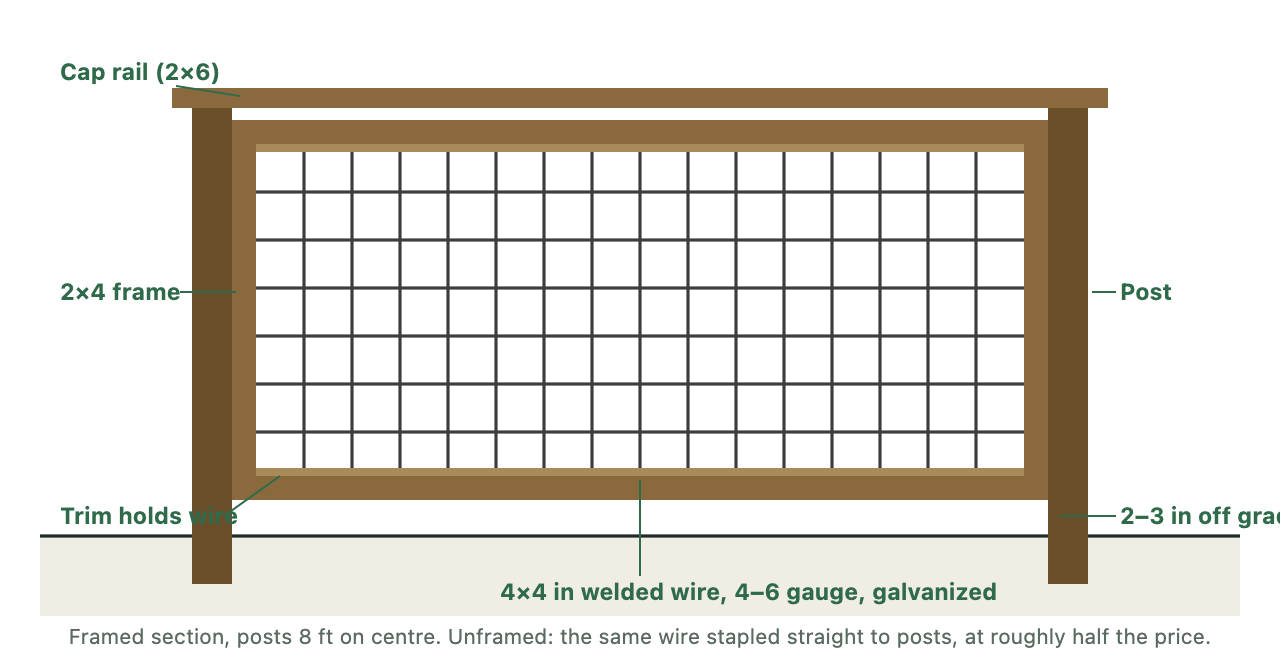
A hog wire fence costs $10–$20 per foot with the panels stapled to posts and $22–$65 per foot framed in wood — the modern-farmhouse look that made it popular. The wire is a cheap 4-gauge livestock panel; the framing is the money. It holds most dogs, sees through to the view, and passes many HOAs that ban chain link. It rusts at the cut ends first, gives no privacy, and its 4×4 grid is a ladder — which is why it cannot be a pool barrier.
What you are actually buying
“Hog wire” is a livestock word for a residential product. The panel is a rigid welded grid of 4- to 6-gauge galvanized steel rod, 16 feet long, with 4×4-inch openings, sold at farm stores for pens. Framed in cedar between posts and topped with a cap rail, it turned into one of the most-requested fence styles of the last decade, and the names got confused on the way.
| Panel | Size | Openings | Wire | Notes |
|---|---|---|---|---|
| Utility / 'hog wire' panel | 4 ft × 16 ft | 4×4 in, uniform | 4–6 gauge | The residential product. Uniform grid, clean look, framed or unframed. |
| Hog panel | 34 in × 16 ft | 4×4 in top → 2×4 in bottom | 4 gauge | Tighter at the bottom to stop pigs rooting under. Short for a fence; useful as a lower course. |
| Cattle panel | 50 in × 16 ft | 8×6 in top → 4×4 in bottom | 4 gauge | Bigger openings up top. Cheapest per foot; reads as agricultural. |
| Welded wire, rolled | 4–6 ft × 50–100 ft | 2×4 in | 12.5–14 gauge | Not a panel — it sags without tension and looks it. Cheaper; a different fence. |
The distinction that matters on a quote is panel versus roll. Rolled welded wire is 12.5–14 gauge and needs tension to stay flat; it sags between posts within a season and reads as temporary. A panel is 4–6 gauge and holds its own shape. If a “hog wire” quote is suspiciously cheap, ask whether it is panels.
Cost: framed is where it doubles
| Build | Installed / ft | Notes |
|---|---|---|
| Unframed, stapled to wood posts | $10 – $20 | Wire straight onto 4×4 posts 8 ft apart, cap rail optional. The agricultural look, priced like chain link. |
| Unframed on T-posts | $6 – $12 | Rural runs. Not a residential fence in most HOAs' eyes. |
| Framed in treated pine | $22 – $45 | Each section boxed in 2×4s with trim. This is where the modern-farmhouse look starts. |
| Framed in cedar, with cap rail | $30 – $65 | The photograph everyone brings to the contractor. Frame material is most of the premium. |
| Black wire and black frame | +10 – 25% | Powder-coated or vinyl-coated panels plus a solid stain. Visually recedes; costs more. |
A 16-foot panel costs $25–$60, so the wire itself is $1.50–$4 per foot. Everything above that is posts, frame lumber, and labour — which is why the cedar-framed version costs three times the unframed one for the same wire. For a 150-foot yard: about $1,500–$3,000 unframed, $3,300–$6,750 framed in pine, $4,500–$9,750 framed in cedar. Price your run with gates as separate lines; a framed hog wire gate is a custom build at $400–$900.
Dogs: good, with the two usual caveats
This is where hog wire earns its keep. The panel is rigid, so a dog leaning or jumping against it does not stretch it the way rolled wire or even chain link fabric deforms. Four feet holds most breeds; six-foot panels exist for jumpers. The 4×4 grid holds anything larger than a small puppy.
- Climbers. The grid is a ladder — every horizontal wire is a foothold. An athletic dog goes up it. The fix is height or an inward-angled top, same as chain link.
- Diggers. The panel stops 2–3 in above grade so it does not rust in the soil, which is exactly where a digger starts. Pin the bottom rail or add a buried apron.
- Tiny dogs and puppies. A 4×4 opening passes a small head. Use a hog panel (2×4 at the bottom) or a 2×4 welded lower course.
Rust: where and when
Galvanized steel rusts when the zinc is gone, and the zinc goes first where it is thinnest or missing. On a hog wire fence that is three places, in order: the cut ends, which have no coating at all; the welds, where the zinc is thinnest; and wherever the panel touches wet ground or wet wood.
Hot-dip galvanized panels — the kind with a slightly rough, matte zinc surface — go 20–30 years before rust matters. Electro-galvanized panels, smoother and shinier, show rust at the welds in 5–10. Black powder-coated panels last longest and cost most. Whatever you buy, the panel is cut to fit each frame, so every section has fresh bare ends; a crew that hits them with cold-galvanizing spray before trimming adds years for pennies.
Why it cannot be a pool fence
Pool barrier codes ask two things of the fence itself: that a 4-inch sphere cannot pass through any opening, and that there are no footholds in the lower portion — horizontal members closer than 45 inches must be on the pool side. A 4×4 grid fails the sphere test at the margin and the foothold test completely, because every wire is a step. This is a frequent, expensive surprise on properties where a hog wire fence was built first and the pool came later. Use it elsewhere on the lot; the barrier needs vertical pickets or fine mesh — see pool fence requirements.
Hog wire vs chain link vs welded wire
vs chain link
Same job, same price unframed, both climbable, both hold dogs. Hog wire looks better and looks intentional; chain link handles slopes and height more easily and installs faster. The practical difference is the HOA: boards that ban chain link as “industrial” frequently approve framed hog wire as an open fence. See chain link cost.
vs rolled welded wire
Half the price and a different product. Rolled wire is light gauge, needs tensioning, sags, and looks like a garden fence because it is one. If the budget only stretches to rolled wire, chain link is the better-looking cheap fence.
vs horizontal wood
The two are often built together — hog wire sections between runs of horizontal boards, or hog wire on the side yards and horizontal along the street. Hog wire costs less, sees through, and does not have the span problems horizontal boards do.
When hog wire is the wrong choice
- Privacy. None, and slats do not work in a 4×4 grid.
- Pools. Above.
- Deer. Four feet is a hop. See deer fence height.
- Steep slopes. Framed sections step; every step leaves a triangular gap. See fencing a slope.
- Coastal salt air. Galvanizing goes fast; buy coated or accept a shorter life.
How to sanity-check a hog wire quote
- Panels, not rolls — and the gauge (4–6)
- Coating: hot-dip galvanized, electro-galvanized, or powder-coated
- Framed or unframed, and the frame species (pine vs cedar is most of the price)
- Cap rail, trim, and whether cut ends are treated
- Post size, spacing, and depth; concrete at gates and corners
- Gates as separate line items — framed gates are custom builds
Local rules vary. Open-wire fences are treated differently by different jurisdictions for height and front-yard rules, and HOA approval is case by case. Confirm both before ordering panels.
Keep going
Frequently asked questions
- How much does a hog wire fence cost?
- Unframed on posts: $10–$20 per foot. Framed, the usual look: $22–$65 per foot, cedar at the top. Panels are cheap; the framing is the price.
- What is hog wire fencing, exactly?
- Rigid 4×4 in welded-wire panels, 16 ft long, 4–6 gauge galvanized rod. A livestock product adopted as a residential style, usually framed in wood.
- Is a hog wire fence good for dogs?
- Yes, for most dogs — rigid, 4 ft, and the grid holds anything bigger than a small puppy. Watch climbers (the grid is a ladder) and diggers (pin the bottom). Use 2×4 mesh low for tiny dogs.
- Does hog wire fence rust?
- Eventually. Hot-dip galvanized: 20–30 years; electro-galvanized shows rust at the welds in 5–10. Cut ends go first — spray them before framing. Powder-coated black lasts longest.
- Can you use hog wire fence around a pool?
- No — the 4×4 grid is a ladder under pool barrier code and passes a 4 in sphere at the margin. Use it elsewhere on the lot; the barrier needs pickets or fine mesh. See pool requirements.
- Hog wire vs chain link: which is better?
- Similar price unframed, both hold dogs, both climbable. Hog wire looks better and HOAs that ban chain link often pass it; chain link does slopes and height more easily.
- Can you paint or stain hog wire fence?
- Stain the frame, yes. Buy the wire black rather than painting it — paint on galvanized steel flakes unless etched and primed.
- Do hog wire fence posts need concrete?
- Framed: set posts as for any panel fence, concrete at gates and corners. Unframed on T-posts: none. See post depth.
Cost figures are independent 2026 planning estimates compiled from published industry pricing as of August 2026; they are not quotes and vary by framing, coating, region, and installer. Pool-barrier guidance is general — your local code governs. FenceLevel is not a contractor or manufacturer.