Fence on a Slope: Stepped vs Racked, and Which Fences Can Do It
Independent research · Last reviewed September 2026 · Costs are 2026 planning estimates, not quotes
The short answer
There are two ways to fence a slope. Stepping keeps every panel level and drops them down the hill in stair steps — it works on any slope but leaves a gap under each panel. Racking angles the rails to follow the ground with the pickets kept plumb — no gaps, but only some fences can do it, and only up to a limit that ranges from about 5° for standard vinyl to almost anything for chain link. The gap is the real decision.
Stepped vs racked, in one picture
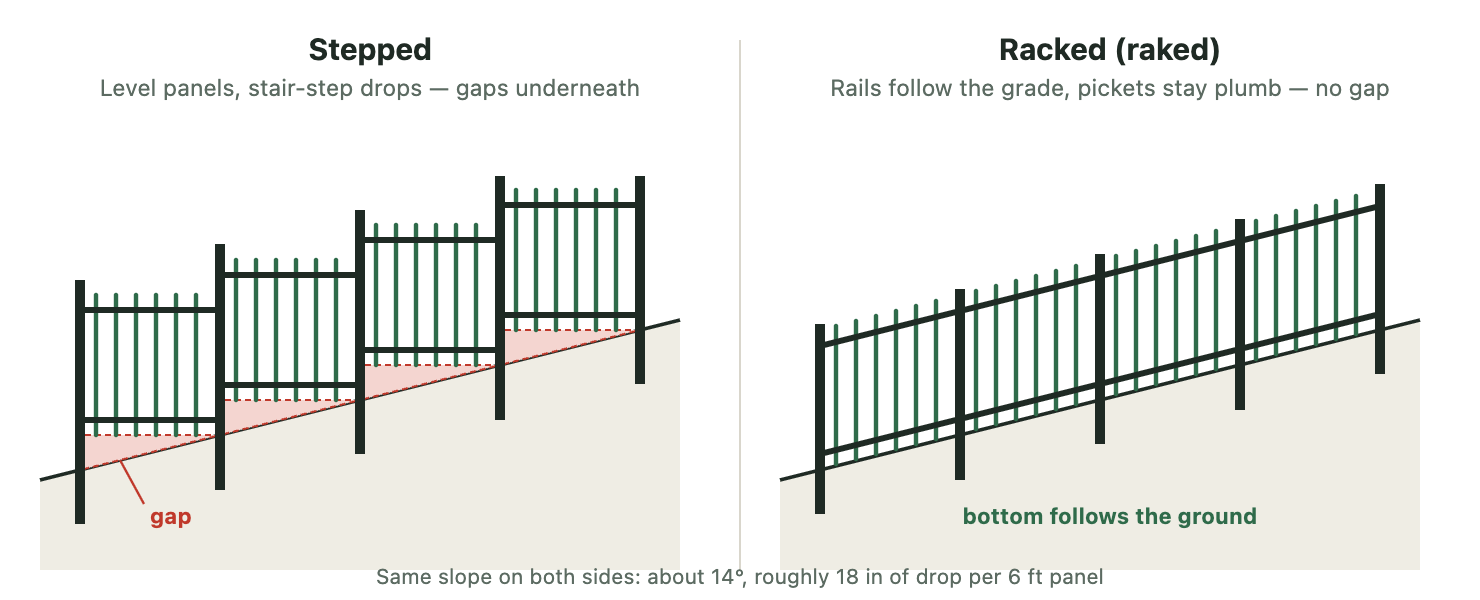
Both are legitimate. Stepping is not the cheap option and racking is not the “proper” one — they are answers to different constraints. Stepping is what you do when the panel cannot flex or the slope is too steep; racking is what you do when the gap matters or you want the top line to read as one continuous edge.
How steep is your slope?
Contractors talk in inches of drop per panel, not degrees, because that is what they can measure with a level and a tape. Run a string line level from the top of the slope and measure down to the ground every 6 or 8 feet; the biggest number decides what your fence can do.
| Drop per panel | Angle | What works |
|---|---|---|
| Under 6 in per 6 ft panel | ≈ 0–5° | Barely a slope. Almost anything racks; stepping looks fussy. |
| 6–12 in per 6 ft | ≈ 5–10° | Standard vinyl and aluminum panels rack to about here without modification. |
| 12–20 in per 6 ft | ≈ 10–16° | Needs a rackable (double- or triple-punched) panel, chain link, or a stick-built wood fence. Many panel fences step here. |
| 20–40 in per 6 ft | ≈ 16–30° | Rackable systems top out around 28–35°. Most installs step. Consider terracing or a retaining wall. |
| Over 40 in per 6 ft | > 30° | Step, or don't fence it. Post footings on a slope this steep are their own engineering question. |
Two things people get wrong here. A yard is rarely one slope — it is usually a steep section and a gentle one, and the fence can rack the gentle part and step the steep part. And the slope along the fence line is what matters, not the slope of the yard; a fence running across a hillside on the contour is flat.
Which fences can rack, and how far
“Can it go on a slope” is the wrong question — anything can step. The right question is how far a given product racks before it binds, because that decides whether you get a gap-free fence or a stepped one.
| Fence | Racks? | Notes |
|---|---|---|
| Chain link | Follows any grade | The mesh and top rail simply run parallel to the ground. Best slope material there is; the reason it wins on hillsides and long rural runs. |
| Wood, built on site | Racks freely | Rails are cut and nailed to plumb posts one section at a time, so a good crew follows the ground exactly. This is the traditional method — stepping a stick-built wood fence is usually a choice, not a limit. |
| Wood, pre-built panels | Step, mostly | Factory panels are rigid rectangles. Some flex an inch or two; beyond that they step, leaving gaps. |
| Aluminum (ornamental) | 0–6 in standard; 16–20 in rackable | Standard panels rack roughly 6 in over a 6 ft section. Double-punched rails reach ~9 in and triple-punched or 'rackable' lines ~16–20 in (about 28°). Order the right panel — it is not a field modification. |
| Vinyl | ~10° standard; ~25–30° rackable systems | Routed-rail vinyl racks a little before the pickets bind in their slots. Rackable vinyl exists but is a specific product line at a higher price. |
| Composite | Limited — usually steps | Rigid boards in channels. Most systems step; a few offer small rack tolerances. |
| Wrought iron / steel | Rackable if fabricated for it | Welded panels are rigid. Custom-fabricated sections can be built to the grade, at custom-fabrication prices. |
| Horizontal slat | Cannot rack | The boards are the cladding and they run level. Every slope is stepped, with a triangular gap at every step. |
The detail that catches people out is the aluminum and vinyl one: racking capacity is a property of the specific panel line you order, not of the material. A standard ornamental aluminum panel racks about 6 inches over 6 feet; a rackable line from the same manufacturer racks three times that. If the quote says “aluminum” and your yard drops 15 inches a panel, ask which panel — because the crew will step whatever arrives.
The gap is the whole decision
Every stepped panel leaves a triangular opening at its downhill end, and on a 14° slope with 6 ft panels that triangle is about 18 inches tall at the post. Three things go through it.
Pets
A small dog walks under a stepped fence; a determined one digs the last few inches. If containment is the point of the fence, either rack it, or plan to close each gap with a cut board, a strip of welded wire, or a buried apron — and price that in, because it is fiddly work crews do not volunteer.
Pool barrier code
This is the one that fails inspection. Pool barrier codes limit the clearance under the fence to roughly 2 inches over a hard surface and 4 inches over grass or gravel, measured on the outside. A stepped panel on any real slope exceeds that at every step. Around a pool on a grade, the fence has to rack, the ground has to be built up under each step, or the panels have to be short enough that each step stays inside the limit. See pool fence requirements.
Water
The gap also works in your favour once. A solid fence racked tight to the ground across a slope is a small dam, and the low side of it collects every storm. If the fence crosses the fall line, leave a deliberate gap or use a gravel board with drainage, and keep the bottom rail off the soil so it does not rot from below.
What slopes do to the price
A slope adds cost in four places, and only one of them is obvious:
- Digging. Plumb holes on a hillside are slower, spoil rolls away, and augers fight the grade. This is the visible premium — our calculator applies 15% for sloped or uneven ground.
- Racked sections. Either a premium rackable product, or on-site custom cutting of every rail and picket. Expect the racked run to price above the flat run per foot.
- Longer posts. A stepped fence needs each post to reach the top of the uphill panel and the footing depth of the downhill one — so posts get longer, and post depth on a slope should be measured from the lower grade, not the higher.
- The wall. Past about 30°, the honest fix is often terracing or a low retaining wall so the fence can sit on something closer to level. That is a separate project with its own permit, and it can cost more than the fence.
Quotes that come in identical for a flat yard and a sloped one are a flag — either the slope was not seen, or the crew intends to step a fence you expected to rack.
Gates on a slope
A gate cannot rack and cannot step. It is a rigid rectangle that has to swing clear of the ground through its whole arc, and on a slope that arc runs uphill on one side. The rules that follow:
- Put the gate at the flattest point on the line, even if that is not where you first wanted it.
- Swing it toward the downhill side, so the leaf drops away from the ground as it opens.
- If it must open uphill, hang it high enough to clear at full swing and accept a larger gap at rest — or use rising hinges, which lift the leaf as it opens.
- For driveways on a grade, a sliding gate avoids the problem entirely.
How height is measured on a slope
Height limits assume flat ground, and slopes expose the assumption. Most codes measure from natural grade, and many specify the lower side of the fence — which means a 6 ft fence on top of a 2 ft retaining wall is, to the inspector, an 8 ft fence. Stepped fences are often measured at the tallest point of each panel, and some jurisdictions average across the run. Front-yard caps of 3–4 ft get very tight on a lot that slopes toward the street.
Local rules vary. How height is measured on sloped ground varies by jurisdiction, and it is one of the commonest reasons a fence fails final inspection. Ask your building department how they measure before you order posts — and see fence height rules.
Step or rack: how to decide
- Containing a dog, or fencing a pool? Rack, or close every gap. Stepping alone does not do the job.
- Privacy fence on a gentle slope? Rack if the product allows — a stepped privacy fence reads as stairs from the street.
- Long rural or hillside run? Chain link or site-built post-and-rail. They follow the ground and cost less doing it.
- Rigid panels on a steep slope? Step, keep the steps small by using shorter panels, and terrace if you can.
- Buying a panel fence? Get the rack rating of the specific product line in writing, in inches per panel, before signing.
What to check on a slope quote
- Whether the run is racked, stepped, or mixed — and which sections are which
- For panel fences, the rack capacity of the specified product in inches per panel
- Post length and depth measured from the lower grade at each post
- How gaps under stepped panels will be closed, if containment matters
- Gate location relative to the flattest point, and swing direction
- Whether a retaining wall or grading is in the scope, or assumed done by others
Keep going
Frequently asked questions
- What is the difference between a stepped and a racked fence?
- Stepped keeps each panel level and drops in stair steps, leaving a gap under every panel. Racked angles the rails to follow the ground with plumb pickets, so there is no gap. Any slope can step; only some can rack.
- How steep a slope can a fence be racked on?
- Standard vinyl and aluminum panels: about 6–12 in per 6 ft (5–10°). Rackable systems: around 25–30°. Chain link and stick-built wood: almost anything. Past 30°, step.
- Can you install a vinyl fence on a slope?
- Yes — standard panels rack to about 10°; beyond that you step them or order a rackable vinyl line. Stepping is fine visually; the gap under each step is the thing to plan for.
- Which fence is best for a sloped yard?
- To follow the grade: chain link or stick-built wood. For a panel look on a moderate slope: rackable aluminum. On a steep slope: step it, and consider terracing so the steps stay small.
- Does a fence on a slope cost more?
- Typically 10–20% more — slower digging, premium or custom-cut racked sections, longer posts for steps. Our calculator applies 15% for sloped ground. A retaining wall is a separate job.
- How is fence height measured on a slope?
- Usually from natural grade, often on the lower side — so a 6 ft fence on a 2 ft retaining wall can count as 8 ft. Confirm locally before you order.
- Can a gate be racked or stepped?
- No — a gate is a rigid rectangle that must swing clear through its whole arc. Put it on the flattest point of the line, and swing it toward the downhill side.
- Can I build a fence on top of a retaining wall?
- Often, with three catches: the code usually measures wall plus fence, posts near the wall need a setback or an engineered detail, and a fall-height wall may require a guard regardless.
Racking capacities are typical of products on the market as of August 2026 and vary by manufacturer and line — confirm the specific panel you are quoted. Pool-barrier clearances and height-measurement rules are general; your local code governs. FenceLevel is not a contractor or manufacturer.