Deer Fence Height & Cost
Independent research · Last reviewed September 2026 · Costs are 2026 planning estimates, not quotes
The short answer
A deer fence needs to be 7½ to 8 feet tall — 6 ft only works around a garden small enough that a deer cannot land in it. Installed, that runs about $3.50–$9 per foot in black polypropylene mesh and $6–$15 in metal. The two things the height tables leave out: deer go under a fence long before they go over it, and a fence they cannot judge — a double fence, a slant, or a solid one — beats a taller fence they can.
How tall, by situation
| Height | Where it works | Why |
|---|---|---|
| 6 ft | A small enclosed garden — under about 25×25 ft | Deer will not jump into a space they cannot land and turn in. Works only when it is small. |
| 7½ ft | Most back yards and perimeters up to ~500 ft | The residential standard. Stops nearly all deer under normal pressure. |
| 8 ft | Large areas, established deer trails, orchards and vegetable plots | The agricultural standard. Add it where the food is worth the jump. |
| 10 ft | Near-certain exclusion | Rarely needed residentially; game-farm territory. |
A whitetail can clear 8 ft from a standstill, so no height is absolute. What the numbers encode is deer behaviour: they are cautious jumpers that will not commit to a jump without a visible, safe landing. Height works by making the landing hard to judge, which is why the same 6 ft fence stops deer around a tight garden and fails around an open lawn.
Three ways to beat 8 ft without building 8 ft
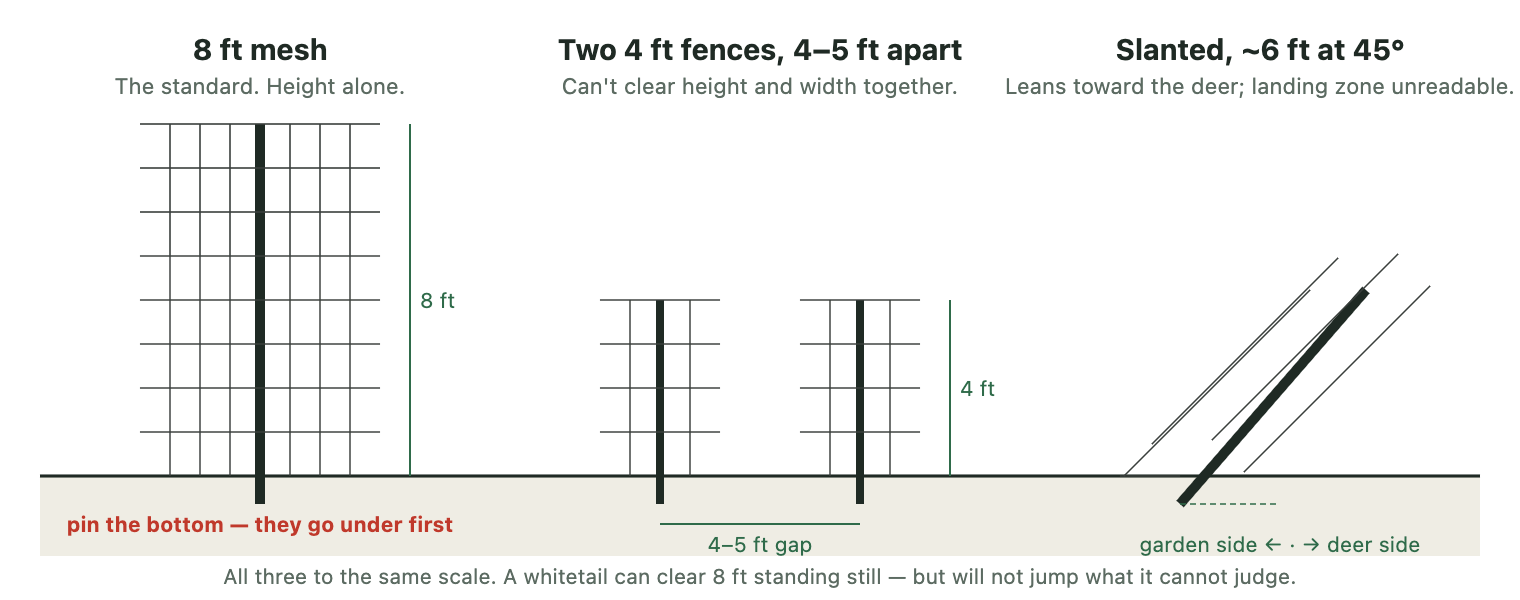
The double fence
Two 4 ft fences, 4–5 ft apart. A deer can clear 4 ft of height or 5 ft of width, but not both in one jump, and it will not land between them. This is the cheapest way to protect a garden under an 8 ft height cap, and the inner run can be an existing fence.
The slant
A 5–6 ft fence leaning outward at about 45°, toward the deer. From the approach side the top of the fence is over the animal's head and the landing zone is hidden behind the slope. Used on orchards for decades; awkward to mow around, which is why it stays there.
The solid fence
A 6 ft solid privacy fence stops deer that an 8 ft mesh would not, because they cannot see what is on the other side and will not jump blind. If you were going to build a privacy fence anyway, you may already have a deer fence.
The visibility paradox
Deer judge a fence they can see and try it if the numbers work. A black polypropylene or coated-metal mesh is close to invisible from a few yards, so most deer never size it up — they walk to it, touch it, and turn. That is why black mesh outperforms the same height in bright galvanized wire, and it is the reason nearly every deer-fence product is black.
The catch is the first month. A deer that has used a trail for years does not know the fence is there and runs into it, which damages mesh and, occasionally, deer. Tie white flagging tape every 10–15 ft at deer eye height for the first four to six weeks so the local animals learn the line, then take it down and let the fence disappear again.
They go under first: the bottom is where it fails
Almost every report of deer “jumping” a good fence is a deer that walked under it. A gap of 6 in or more at grade is an open door; mesh that is not pinned gets nosed up and pushed through. The bottom edge needs one of two treatments:
- Ground stakes every 4–5 ft along the bottom of the mesh, driven through the bottom row into the soil.
- An apron — the last 12 in of mesh bent outward flat along the ground and pinned, which also stops rabbits and groundhogs digging at the line.
On uneven ground the mesh follows the grade easily, but each dip is a gap. Walk the line after storms and in spring; a fallen limb across mesh is a ladder as well as a hole. On a real slope, see fencing a slope.
Poly vs metal mesh
| Mesh | Material / ft | Life | Notes |
|---|---|---|---|
| Polypropylene mesh | $1 – $3.50 / ft | 10–20 yrs | Black, near-invisible, light. Buy 650–800 lb breaking strength or better; cheap mesh is chewed by rodents and pushed through by deer. |
| Welded wire (14 ga) | $1.30 – $3 / ft | 15–20 yrs | Rigid, cheap, galvanized. Shows more than poly; fine on a perimeter that is not a view. |
| Fixed-knot woven wire (12.5 ga) | $2 – $4 / ft | 25–30+ yrs | The farm product. Strongest and longest-lived; needs bracing at corners and ends. |
| Steel-hex or PVC-coated metal | $2.50 – $5 / ft | 20–30 yrs | Poly's looks with metal's bite resistance. The premium residential choice. |
Poly is the residential default because it disappears and it is light enough to hang on slender posts 12–15 ft apart. Its weakness is teeth: rodents chew it at the bottom and a pressured deer pushes through thin grades. Buy by breaking strength — 650 lb or better — not by price. Metal mesh is for heavy deer pressure, rural perimeters, and anywhere the fence will double as a dog fence. Standard hog wire panels look right but stop at 4–5 ft, which a deer clears without thinking.
What it costs
| Job | Cost | Notes |
|---|---|---|
| Materials only, poly mesh kit | $2 – $6 / ft | Mesh, posts, ties, ground stakes. The DIY number. |
| Installed, poly mesh | $3.50 – $9 / ft | The common residential job at 7½ ft. |
| Installed, metal mesh | $6 – $15 / ft | Heavier posts, corner bracing, more labour. |
| Gates | $150 – $600 each | A deer fence gate has to be as tall as the fence and close by itself. |
| Typical ½-acre perimeter (~600 ft) | $2,100 – $5,400 poly · $3,600 – $9,000 metal | Before gates. Fencing the garden alone is a tenth of this. |
Deer fence is the cheapest tall fence there is because the mesh weighs almost nothing and the posts are far apart. The cost driver is the perimeter length — which is the argument for fencing the garden, not the yard. A 30×40 ft vegetable plot is 140 ft of fence, can be 6 ft instead of 8, and costs a tenth of a half-acre perimeter. Price a run with the gate as its own line: a deer gate has to be as tall as the fence and close on its own.
Height rules, and the exemption to ask for
Eight feet is over the 6 ft residential cap almost everywhere, so a deer fence is a permit question before it is a fence question. Many jurisdictions treat open mesh or agricultural fencing differently — exempting it from the cap, allowing it outside the front setback, or permitting it on lots over an acre — but the exemption is something you claim, not something you get. HOAs are the harder audience and frequently object to any visible deer fence, which is one more argument for black mesh.
Local rules vary. Height caps, open-fence exemptions, and front-yard rules are all local. Confirm with your building department and read your HOA covenants before ordering — see fence height rules.
Repellents, honestly
Spray repellents are the most-searched deer product there is, and they are not a fence. They reduce browsing on a few shrubs when reapplied every few weeks and after every rain, and they stop working in late winter when the deer are hungry enough not to care. For ornamentals you can reach with a sprayer, that trade can be fine. For anything you grow to eat, or any bed you cannot re-spray on schedule, it is a subscription that a one-time fence replaces.
Keep going
Frequently asked questions
- How high does a deer fence need to be?
- 7½–8 ft for most yards. 6 ft only works around a small enclosed garden deer cannot land in. 8 ft where the food is worth the jump; 10 ft is near-certain and rarely needed.
- Can a deer jump an 8-foot fence?
- Physically, yes — a whitetail can clear 8 ft standing. It works because deer will not jump what they cannot judge, and 8 ft is past what most attempt. Fences fail underneath far more often than over.
- How much does a deer fence cost per foot?
- Installed: $3.50–$9 per foot for poly mesh, $6–$15 for metal. DIY poly kits $2–$6/ft. A 600 ft perimeter runs about $2,100–$5,400 in poly.
- Will deer go under a fence?
- Yes — and first. A gap over about 6 in is an invitation. Pin the bottom every 4–5 ft or apron it outward. Most “jumped” fences were walked under.
- What is the best fence to keep deer out?
- Whole yard: 7½ ft black mesh. Visible garden: a 6 ft solid fence they cannot see over. Under 8 ft: a double 4 ft fence or a 45° slant — geometry instead of height.
- Do you need a permit for a deer fence?
- Often — 8 ft is over the usual 6 ft cap. Many towns exempt open mesh or agricultural fence, but you have to ask. HOAs are stricter. See fence permits.
- Should I fence the whole yard or just the garden?
- The garden. It can be 6 ft instead of 8, uses a tenth of the fence, and is where the damage is. Fence the perimeter only if the whole property is being browsed.
- Do deer repellents work instead of a fence?
- Partly, and only while you keep spraying — every few weeks and after rain. Fine for a few shrubs; not a substitute around a vegetable garden. A fence is once; repellent is a subscription.
Cost figures are independent 2026 planning estimates compiled from published industry pricing as of August 2026; they are not quotes and vary by mesh, terrain, and installer. Height and deer-behaviour guidance follows state wildlife-agency recommendations; results vary with deer pressure. Permit guidance is general — your local code governs. FenceLevel is not a contractor or manufacturer.